

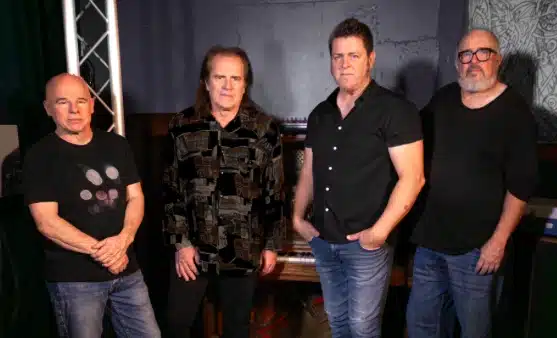
Los Angeles prog quartet Pattern-Seeking Animals return on August 21, 2026 with their sixth album, Grimalkin (Giant Electric Pea), and the band’s mastermind, John Boegehold, sat down with Lots of Muzik’s Mladen Tatljak to talk about the record, his approach to writing, and why keeping a prog band on the road in America is easier said than done.
Six albums in roughly seven years is a remarkable pace, and as the conversation makes clear, it comes down to one simple fact: Boegehold never stops writing.
Read the Full Interview
Prefer to read? Here’s our full conversation with John Boegehold, lightly edited for length and clarity.
Pattern-Seeking Animals: John Boegehold Interview
On the new album Grimalkin (out August 21, 2026, GEP Records / Giant Electric Pea) Interview by Mladen Tatljak for Lots of Muzik
Mladen: Hello everybody, Mladen here from Lots of Muzik, and I’m sitting here today with Mr. John Boegehold from Pattern-Seeking Animals. Welcome, sir.
John: Thank you very much. Good to be here.
Mladen: It’s great to have you here. We have a lot of exciting things to talk about, so let’s get right to it. We want to talk about the sixth album by Pattern-Seeking Animals, Grimalkin, out on Giant Electric Pea on August 21st. My first question is more about the name of the album than the music itself. I’ve been curious about this, it’s a 16th-century term for a great cat, from what I can gather, and I’ve been wondering how it comes into play with the songs or the lyrical content of the record.
John: It doesn’t. I generally don’t name albums after songs. I usually just try to find a cool title that people will remember and that no one else is using. Because I write so many lyrics, I keep a running list, it’s about 150 single-spaced pages in a Word document: lyric ideas, band names, song titles, album titles. When it comes time to do an album, I start going through it thinking, “Oh, that’ll make a good title.” I remembered reading about “Grimalkin.” It’s from Shakespeare, and it referred to a cat that’s a sidekick or a helper for a witch, for a witches’ coven. I thought that was interesting, so I kept it. When I was choosing the album name, the first thing you do is make sure no one else is using it.
Mladen: Right, you Google it right away.
John: Right away. And no one was, which is perfect, because one of the really annoying things about making an album is coming up with a name. Band names are always tough, and album names are tough too. So once you nail it down, it’s like, “Good, that’s off the list, I don’t have to think about it anymore.” From there, once I had the name and that image of the great cat, or the evil cat, I started looking for cover artwork to match it. I follow hundreds of artists on Instagram, so I started going through them, and the minute I saw the artwork we ended up using, it just clicked. I contacted the artist and licensed it. It turned out really well.
Mladen: That’s fascinating with the names, because it’s always infuriating, even as a music fan, to have three different bands under the same name. And it’s similar with album titles.
John: Oh, yeah. You have to make sure. There are millions of album titles out there, so maybe someone’s used it, but as long as I can get something unique, or that’s very rarely been used, I’m good with it.
Mladen: Let’s talk about the record label. This is the second record you’re releasing on Giant Electric Pea. I’ve been curious about the working relationship with the label and how satisfied you’ve been so far.
John: Oh, it’s great. Mike and Anne, everyone’s great. It’s a small label, obviously, but they do a great job, and they’re super responsive. The thing I like about them, and InsideOut was the same way, is that there are no suggestions, no trying to get into what the album should be. In the past, if you’re with a bigger label, you turn in all your music and they’ll say, “Yeah, these songs are good, but we need another downtempo song,” or “We need a longer one,” or “We need a ballad.” That’s super annoying. With GEP, I just turn the record in and they put it out and they’re happy. I say, “It’s ready, when can we put it out?” They give us a date, I say, “Okay, the singles come out then,” and they work with it. They’re super easy to work with.
Mladen: That’s the kind of trust you want from your record label.
John: Yeah. After we left InsideOut, Thomas Waber (who runs InsideOut and is also part of GEP) told me, “You should check out GEP.” I also looked at a few other labels at the time, but I got on a Zoom call with Mike, we hit it off, and thought, “Perfect, let’s do it.” It’s worked out great. I’m really happy.
Mladen: Wonderful. I wanted to ask you about songwriting. This goes back to the beginning of Pattern-Seeking Animals, but it also relates to the new album. You’ve also been heavily involved with Spock’s Beard, you’ve written a lot for them, and Ted has sung for Spock’s Beard for about 15 years now. Pattern-Seeking Animals clearly have their own thing. Is there a conscious effort to make it different from Spock’s Beard, or are you just being yourself, and if it sounds like Spock’s Beard, it sounds like Spock’s Beard?
John: It’s kind of the opposite. I stopped working with them after their Noise Floor album, which was before Pattern-Seeking Animals started. What you’re hearing now is the way I see music, the way I think it should be. When I was with Spock’s Beard, I was tailoring what I wrote to the people in the band. I’d write something and think, “I’m playing this on keyboards, but Ryo would never play that, so we need to move it toward something he’d do,” or the same with the guitars. With Pattern-Seeking Animals, if I’m writing something and I want it to go into a bluegrass bridge…
Mladen: You’re more than allowed to do that.
John: Absolutely, and I love that stuff. With Spock’s Beard I’d think, “There’s no way you’re going to do this,” even though I thought it would be really cool. But that’s the case anytime you’re writing for another group or person that isn’t you, you take into account the artists, their vibe, and what they want to do.
Mladen: Their respective styles and influences, yeah.
John: Yeah.
Mladen: Another thing that intrigues me is the balance between the expected prog-rock epicness and certain songs that are catchy, snappy, and to the point. Is that also a conscious effort?
John: No. When I’m doing an album, I don’t sit there and think, “Okay, I’m going to do a prog epic that’s 20 minutes long, then I’ll do this.” I just start coming up with material. Because I like so much stuff, it happens naturally. There are a couple of songs that are obvious, I don’t want to call them pop, but they’re shorter, more structured, to-the-point songs, and then there are some that go a little further out there. I just want good songs, cool songs. Whether they fit the “prog” market or not, as long as it’s good. I figure if I like it, and I like all the prog groups, then maybe other people will like it too. So there’s no effort in that whatsoever. I think prog artists sometimes dig themselves into a hole, going, “We’ve got to be prog, we have to do a 22-minute song, we can’t do something in 4/4.” You can kind of paint yourself into a corner. Just write good music.
Mladen: There’s still a lot of diversity within the genre. I find it really interesting that certain bands are always drawn to long-form compositions, while nowadays in progressive metal, for example, there are bands that deliver four- or five-minute songs that are still really complex. Having both is stimulating on the ears, the epic side and the concise, three-to-four-minute songs.
John: Yeah, and I like a lot of the newer prog-metal stuff where they integrate Celtic instruments or different instrumentation you wouldn’t normally hear in metal. A lot of bands, especially European and Norwegian ones, do that, which I always think is really cool. They go into left field in a way you wouldn’t expect from a metal band.
Mladen: Yeah, it makes for a more entertaining listen.
John: Oh, absolutely.
Mladen: Another question that relates to Spock’s Beard to an extent: you’ve redone several songs over the years, like “Bulletproof” and “No One Ever Died and Made Me King.” Those were initially released as B-sides or bonus tracks. How do you decide, “Okay, this particular song could be redone and put out as a Pattern-Seeking Animals song”?
John: Well, the other one, from the last album, was…
Mladen: “Days We’ll Remember.”
John: “Days We’ll Remember.” Fantastic. Here’s my feeling about it. As a music fan in general, I hate the idea of bonus tracks. Realistically, if I get an album and there’s a bonus disc, I might listen to the bonus side once, and that’s it. If you go on Spotify, take “Days We’ll Remember,” which was on the bonus disc to Noise Floor, all the songs on the main album have like 700,000 or 500,000 listens, and the bonus track has maybe 2,000. No one ever hears that stuff. So my feeling was, if it had been on the main album, I wouldn’t have redone it. But those three, “No One Ever Died and Made Me King,” which Dave and I wrote a long time ago, was a bonus track and turned out really good, and with “Bulletproof” and “Days We’ll Remember,” I wasn’t really happy with how they turned out anyway, besides being relegated to the bonus disc. So I figured, “What the hell, I’ll just redo it the way I really want it done.” It’s not really a question of whether I should or shouldn’t; I’m just looking for good songs. Some people probably think, “Why is he doing that?” but the reality is most fans have never heard these songs.
Mladen: I’m sort of with you on the whole concept of bonus discs, and maybe even EPs, to an extent. That can be tricky too.
John: Yeah, it’s tricky. In the digital realm, if I’m listening to a band, let’s say Flower Kings, and they put out an album, then six months later release a single or an EP, it’s like, “What do I do with this?” It’s a cool song, but if I’m going to listen to an album… it’ll just end up in shuffle with a bunch of other songs. I understand why people do it, especially if you don’t put out an album very often, if you only release one every four or five years, then putting out a live cut or an alternate version once in a while makes sense. But I tend to look at it as a fan, and it’s just something I’m not crazy about.
Mladen: I’m absolutely with you.
John: Albums are already too long. By the time you start adding extended versions… If you’re buying an album on iTunes, I do everything digital, and there are two versions, one with 12 songs and one with an 18-song extended version, I’ll never go with the extended one. I just want the concise album the way the band originally heard it.
Mladen: That makes perfect sense. Sometimes bands release an EP with four songs and I wish they’d done another four and made a full record out of it.
John: Yeah. Back in the day, Genesis used to do that, they’d do an album and then put out an EP, like “Spot the Pigeon.” Great songs, but it doesn’t really fit anywhere. You don’t pull the EP out to listen to it, and when the songs come up you think, “Oh, that’s cool, why wasn’t this on Wind & Wuthering?”
Mladen: Exactly, why didn’t it make it onto a certain album? Another thing I wanted to ask, and this might be a cool question for Ted or Dave to chime in on too. When you send out demos, from what I’ve read, a lot of the music you write is already detailed and well-crafted when it’s demoed. When you get feedback from, say, Ted, does he find it difficult to sink his teeth into, or has it become intuitive over the years for them to get the ideas you’re putting across?
John: With Dave, not so much, the bass and drums, because by the time I have a song, it’s not really a demo per se; the tracks I’m working on become the actual song. Everyone just adds their stuff to it. I build it up, and once I have the structure done, I get together with Jimmy and we go to the studio and record the drums on those tracks. Then I send them to Dave, and he adds his parts, and by the time everyone adds their parts, that ends up being the song. For drums, I’ll put a scratch drum part on the basic track, a basic feel for the groove, but from there I don’t try to tell Jimmy what to do. Here’s the feel; go for whatever you think is cool. With Dave, I’ll write most of the bass part, but there are always sections where I’ll say, “Okay, here’s 45 seconds, just do something cool.”
Mladen: Like a bassline of his own.
John: Yeah. And several times Dave or Ted will say, “This is really cool, but wouldn’t it be cooler if you went to this section instead of that one?” And I’ll go, “Oh, good idea,” and move things around before they actually record. With Ted, I usually check songs for the key of his voice, I pretty much know where his sweet spot is now, but on some songs I’ll send him a very early version and say, “I think I want this one in a lower register, what do you think?” and he’ll go, “Yeah, drop it down a minor third.” He gets to hear my crappy scratch vocal, and I always tell him, “If you want to do something different here, go ahead.” Sometimes he’ll text me and say, “This section should be an octave down,” or “I’d like to add harmonies here.” Great, whatever’s cool. The last thing I want to be is intense about “you have to do this exactly the way I see it.” They’re all such good players. Same thing with guitar: “Here’s 16 bars, do a solo here.” I just tell them where.
Mladen: Speaking of solos, toward the end of “Flower Yet to Grow” there’s this frenetic guitar solo. I can imagine Ted getting a real kick out of it once you send the tracks, it’s a perfect spot for a solo.
John: Yeah, I love that solo. There’s also a slide-guitar solo in the middle that goes into the bridge. Originally he sent me the version with that solo underneath the vocals, but I thought, “This is such a cool solo, I don’t want vocals over it.” So I put about 32 bars in front of the vocals and moved the solo there, so now it starts with that slide solo out by itself. It’s almost like David Gilmour’s slide playing, which is really cool.
Mladen: I’m so happy you said that, because I got a Pink Floyd vibe from that section too.
John: Oh, absolutely. Big reverb, slide guitar, no doubt.
Mladen: Let’s talk about potential plans for taking Pattern-Seeking Animals on the road. I know you don’t tour, but is that something being talked about? Is Ted into it?
John: I think the guys would be into it. But you’re right, I don’t play in a live band. The problem is that being a prog band these days, especially in America, is really tough financially and logistically. We’ve done a few things, like Cruise to the Edge and ProgStock a couple of times, which was great. But just the logistics of getting the band together to rehearse, we’re all in different parts of the country. I’m in Southern California, Dave‘s in Northern California, Ted‘s in New York. Every once in a while we get an offer, and I wouldn’t mind going a little out of pocket to make it work, because it’s good to be out there promoting. But a lot of the time, between the logistics and, especially in Europe, visas, flights, and hotels, it would just be a giant money suck. We were offered one festival in Europe last year, and when I looked at it, it would have cost the entire budget for another album. So it’s like, what’s the point? If something makes sense, we’d love to do it, but it’s rough right now. I’ll say this, I get Prog magazine every month, and in the back there are pages and pages of local clubs with prog groups playing, mostly in England. If we lived in the UK, we could book a gig at a local club, rehearse in the basement, and just go play. It wouldn’t be this giant money pit.
Mladen: You could do two weeks’ worth of club shows in the UK.
John: And if it didn’t make a lot of money, who cares, because you’re just driving down the road to the club to hang out and play. But it’s a multifaceted thing trying to get a prog group together, so…
Mladen: That’s how it is these days, I guess. But it’s perfect that you have six albums’ worth of material within six or seven years. When you’re not touring, you can at least keep pumping out records.
John: Yeah, I write continually. I’m always writing.
Mladen: That’s what I was curious about. By the time the fifth album, Friend of All Creatures, came out, there was already talk about Jimmy recording drums for the sixth.
John: Oh, yeah. In fact, right before I came on with you, I was back in my studio working on one of the songs for the next album.
Mladen: That’s exactly where I was going with this.
John: I’m not quite ready to have Jimmy do drums yet. What I like to do is have at least half the album done, then go to the drum studio and lay down all the drum parts in a day. I haven’t reached that point yet, but over the next couple of months I’ll have it together, and we’ll go from there.
Mladen: It’s nice to have confirmation that there’s still more music to come.
John: Oh, I write all the time. Even if I didn’t have a record deal or a band, I’d be writing music, because I love doing it so much.
Mladen: Wonderful. Let’s wrap up with this question, it’s usually an entertaining one for viewers. When you play the new record, is there a particular song that really draws you, that makes you think, “Oh, we really nailed it with this one”?
John: It’s funny, I don’t listen to the albums too much unless I have to, for a live show or some specific reason. Sometimes I’ll go back to an earlier album after a couple of years and think, “This song shouldn’t even have been on the album, why did I…” When you’re in the moment it seems cool, but in retrospect you think differently. I’m not great about that. For this album, though, I’m really happy with all the songs and the way they turned out, because the guys nailed it. That’s the thing, if I don’t think a song’s been nailed, I won’t mix it, I won’t put it on the album. For example, there’s a song on the new album called “I Dream the World” that I’m really happy with. This is about the fourth version of that song. I originally wrote it around the time of the first album, but it wasn’t the right tempo, so we didn’t do anything with it. I came back a couple of albums later, tried it again, and the recording didn’t work out. We were going to do it on Friend of All Creatures, but there was no space left, so I moved it over to this album, and I’m really happy with how it turned out. Maybe I’ll go back in a couple of years and go, “Ooh, I could have done that differently,” but not bad.
Mladen: That’s the odd thing about looking back with a different perspective on music. But I wouldn’t worry about that song, it makes for a great closer.
John: Yeah, I think so too. It’s interesting, because with prog the tendency is often to close with some big epic, long, slow fade-out with a giant triumphant guitar solo. Believe me, I’m guilty of that, and it can be very cool, I’ve done it on several albums, but for this one, “I Dream the World” just seemed like the right way to end the record.
Mladen: Absolutely. Okay, I think we’re pretty much done. Let’s get the word out one more time: Grimalkin is out August 21st on Giant Electric Pea. Buy it, stream it, incorporate it into your library.
John: Stream it, and you can go to our website, psanimals1.com, or Facebook, or anywhere; we’re all under “PSAnimals1,” the number one, everywhere, Instagram, Facebook, whatever. If you order the album through us via The Band Wagon, you get a nifty signed 5×7 card from all the guys, exclusively if you buy right through us. But it’ll be available everywhere, through GEP, Amazon, all the usual places.
Mladen: Excellent. Well, John, thank you very much for doing the interview.
John: Absolutely. Had a wonderful chat.
Mladen: And for everybody watching, thank you for watching, and we’ll see you around.
If this interview whetted your appetite, don’t miss Mladen‘s full review of Grimalkin, published just a few days ago.
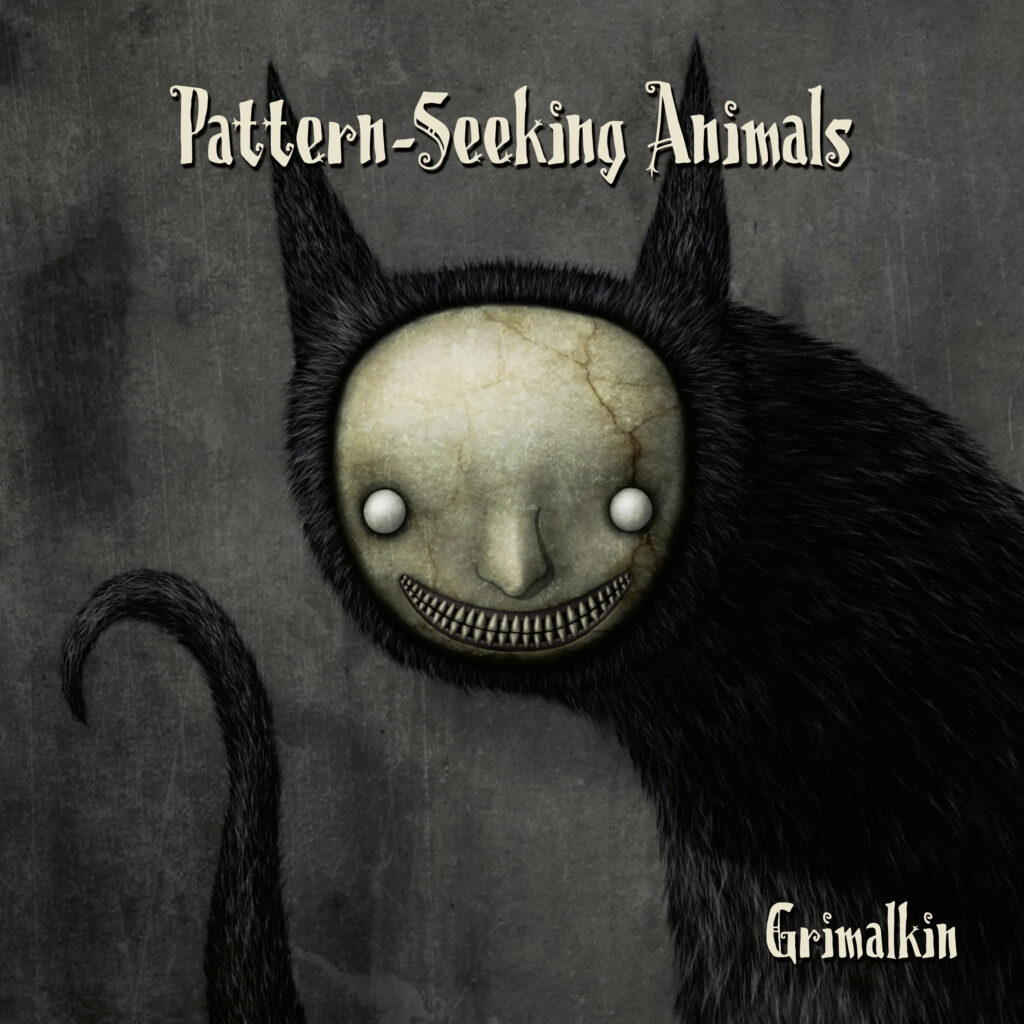
The album is available as a CD (6 panel digi-sleeve with 12 page booklet) and vinyl (gatefold sleeve grey marbled vinyl).
Pre-order here: USA • Europe
Tracklist:
1. Maybe All A Dream
2. A Flower Yet To Grow
3. Jade Sky
4. Things I Don’t Do
5. Break Away
6. Traveler On The Wrong Road Home
7. Slowly Falls The Flying Man
8. I Dream The World
PATTERN-SEEKING ANIMALS ARE:
TED LEONARD
JOHN BOEGEHOLD
DAVE MEROS
JIMMY KEEGAN
PATTERN-SEEKING ANIMALS online:
http://PSAnimals1.com
http://Facebook.com/psanimals1
https://x.com/psanimals1
https://www.instagram.com/psanimals1/
https://youtube.com/@psanimals1


