

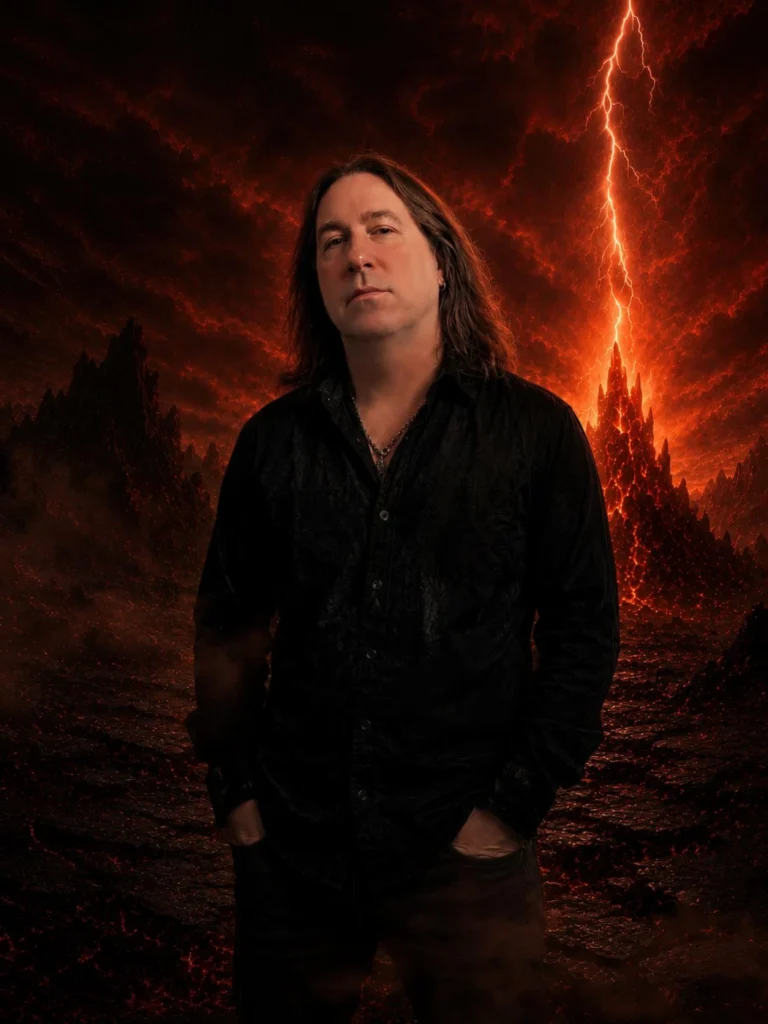
As founding bassist of Symphony X, Thomas Miller played on the band’s first five albums, from the 1994 self-titled debut through The Divine Wings of Tragedy and Twilight in Olympus, before stepping away from music in the late ’90s. Nearly three decades later, he’s back with Thomas Miller’s Lazarus Effect, a progressive metal album released on October 30, 2026 on Sensory Records.
The album reunites the three founding members of Symphony X: guitarist Michael Romeo and keyboardist Michael Pinnella join Miller, with vocalist Hollywood How Portney up front and longtime Symphony X producer Eric Rachel handling the mix and master. We spoke with Thomas about why he waited years for Romeo to be available, how “When Darkness Falls” came together in about an hour, the five-part closer “Sailing to Utopia,” whether he’d ever play with Symphony X again, and his plans for touring and a second album.
Watch the interview
If you prefer to read, here’s the transcript
Edited lightly for clarity and length.
Rodrigo Altaf: Hello, everyone, and welcome to another Lots of Muzik interview. I’m Rodrigo, and my guest today is Thomas Miller of Lazarus Effect. Thomas, thank you so much for joining us.
Thomas Miller: You’re welcome. Glad to be here, man.
Rodrigo Altaf: We’re here to discuss the new Lazarus Effect album, which came out in late October. How has the reception been so far?
Thomas Miller: I’ve only heard from some fans so far, and I’ve talked to the label a little bit. I haven’t had any updates on how well it’s selling, but thankfully the reviews have been very good. Some of the responses are from my friends, so of course they’re not going to say anything negative, but everything’s been positive. I’m very happy. I don’t think I could have asked for a better reception this early on.
Rodrigo Altaf: Excellent. For a lot of Symphony X fans like myself, hearing your bass on a prog metal record again after nearly three decades feels almost surreal. What made now the right time for this album?
Thomas Miller: I actually wanted to record this a while ago. I’ve been thinking about it since around 2007 or 2008, and my idea was always to have Mike Romeo play guitar. I really didn’t want anybody else. But at the time Symphony X were very busy touring, writing and recording, so it would have been fragmented, like, “Okay, dude, I can do two tracks here and then I’ve got to go.” Now they’ve had a break for a while. Mike did a couple of solo records, and I told him, “I think I’ve got everything polished up.” I didn’t say anything to anybody, for a reason. I didn’t want people on my back asking, “When’s it coming out?” I wanted to be able to sit on it and listen to everything. When Mike said, “Yeah, I’m good to go,” I called Mike Pinnella too and said, “Dude, I’d love to have you play on this record as well.” He’s the most easygoing guy in the world. He said, “Yeah, man, just send it to me.” So it was just a matter of when Romeo would have the time to really dedicate himself to the project. I could have had other players, but after playing with Mike, it’s tough to find somebody at that level who I work so well with personally. So I was willing to wait, and I did.
Rodrigo Altaf: (laughs) Yeah.
Thomas Miller: Thirty years! When I first left Symphony X, this wasn’t my immediate plan. I knew I’d do something in the future. But since 2007 or 2008 I’ve been writing here and there, piecing things together and waiting for Mike to give me the thumbs up, and that’s what happened.
Rodrigo Altaf: You chose the name Lazarus Effect as a metaphor for a musical resurrection of sorts. Is there also a conceptual thread connecting the songs?
Thomas Miller: No, I didn’t do a concept album. I had too many different lyrical themes, and linking them would have been a stretch. It wouldn’t have made sense. But I did make a conscious effort to make each song flow smoothly into the next. I knew what the opener was going to be and what the closer was going to be, and I wanted that rollercoaster ride to make sense from one song to another, so nothing jumps out at you unexpectedly or out of context. Maybe I’ll do a concept album in the future. That wouldn’t be a problem. I could do one song an hour long! Anything can happen. But for this album, I chose not to. You’re right about the resurrection, though: coming back into the music business. That’s definitely what the name is about.
Rodrigo Altaf: Very cool. Let me ask you about “When Darkness Falls,” which reportedly came together in about an hour. What sparked that, and how much of the final version was already there after that hour?
Thomas Miller: I had nothing. I was listening to the record and thinking, “What is this missing?” I had the prog stuff, and songs that start with acoustic guitar and build up. So I thought, “Let me put in something more straightforward, a straight metal song,” because I’m a metal fan, not just a prog fan. I actually wrote that riff on the bass. Once I had it, I decided the lyrics shouldn’t be busy. I wanted it kind of simple. I came up with the song title, wrote the lyrics, put the harmonic minor thing in there, and it came together so fast that I thought, “That was too easy,” like it might sound thrown together. But I don’t think it does. Sometimes you’re inspired and you can just belt it out, and sometimes you can’t. This was one of the times it worked out.
Rodrigo Altaf: One of my favorites on the album is “Closer to the Sun.” There’s a bit of a Led Zeppelin and Rainbow influence there, and the story of Icarus is what you’re alluding to, right?
Thomas Miller: Yeah. The whole Icarus title and lyrics came later. I wrote the music first. I had the main crunchy riff, and then I thought I’d start it with a storyline build-up, almost like a Kansas a cappella intro. So I had that line, then I sat down at the keyboard, wrote a chord, and started layering keyboards. It started to get that Middle Eastern, “Kashmir”-ish vibe, and I thought that was cool, because I’m a Zeppelin fan and a Rainbow fan. It just came together. I think it has its own identity, and I’m very happy with how it came out. Of course I gave it to Romeo and he belted it out. That’s one of my favorite solos he did on the record. Not that he’s ever done a bad solo. The guy doesn’t know how!
Rodrigo Altaf: I was going to ask about Michael Romeo’s contribution. How complete were the guitar parts when you sent him the material, and how much freedom did you give him?
Thomas Miller: All the rhythm parts were written, and on most of it he followed what I did. But I know how Mike writes. Even if I have a bass riff, it’s not like Iron Maiden, where the guitars always double the bass. So I knew Mike would take liberties and do his own thing, and I didn’t have to tell him much. Where the riff needed to go, he played it. Where he didn’t want to play it, he didn’t, or he played it and added a little tail here and there. I had so much confidence in Mike. I didn’t write any of the solos, and I made maybe two suggestions, I think on the instrumental and on the closing song: “Mike, this is what I hear.” “No problem, man.” It was so easy. No back and forth, no arguing or disagreeing. We really clicked.
Rodrigo Altaf: You mentioned the last song. “Sailing to Utopia” is a five-part suite. Did you set out to write something that massive, or did it grow from a core idea?
Thomas Miller: I mapped out pretty much the whole record before I started. I knew I wanted a song like that, a “Divine Wings” kind of thing. I just didn’t know how long it would be, ten minutes or twenty. I knew it would be broken into different parts, and it was a matter of matching the story to the music. From the start I knew it would be the big closer for the record, and I did that intentionally. I rarely just write blindly and let whatever happens happen. I ask myself, “What tonality am I going for? What tempo? How heavy is this going to be? What lyrics?” Then I hear things in my head, and I pick up my bass or get on the keyboards or the drums and take it from there.
Rodrigo Altaf: Was Michael Pinnella always your first choice, to rekindle that connection from the Symphony X era?
Thomas Miller: To tell you the truth, I don’t know any other keyboard players! And even if I did, I’d still have chosen him. I’m trying to find a keyboard player for this band right now so I can play live, and the label has thrown out some names, but Pinnella was a no-brainer. We have so much history together in Symphony X, and you can’t even get into an argument with the guy. He’s so easygoing, such a cool dude, and easy to work with. I wanted to get the three core members of Symphony X together, because at first it was just me and Mike Romeo, and then Pinnella. It was really the three of us at the start, so I knew how good it could be. And it was. When Pinnella sent me his solos, I said, “Fantastic.” No corrections, nothing.
Rodrigo Altaf: Now that you’re working with Romeo and Pinnella again, would you consider joining Symphony X for a special occasion, even just one song?
Thomas Miller: A lot of people have been asking me that over the years: “Go back to Symphony X.” But Symphony X has a bass player. I would love it if my band could open for them in the future. That’s one possibility, and then who knows, I might get onstage and join them for a song or two. But I’d have to talk to the band and clear it with Mike LePond. I’m not looking to rock the boat or make waves with anybody. I’m on good terms with him, and I don’t want to send the wrong message to the fans. I love the band and everybody in it. Everything’s on the table if they ever need me. So it could definitely happen, maybe some kind of jam where we all get up there.
It almost happened in 2008. I went to see them in concert and didn’t get to talk to the band beforehand. While they were playing, Russell [Allen] spotted me in the audience. I was about to leave during the last encore to beat the traffic, and next thing you know he calls me out on the mic, the spotlight’s on me, and he’s asking me to come onstage. I was like a deer in headlights! But I went up, hugged everybody, and we took a bow together. Then he said, “Dude, you want to play one?” And I said, “Why didn’t you tell me to bring my bass?” We went backstage afterwards and hung out. I’ve also gotten together with Romeo once and played a bunch of Symphony X songs, and I learned one or two of the newer ones, but that was several years ago. With the old stuff, I’d just have to brush up on some of it, but “Of Sins and Shadows,” “Medusa,” “Sea of Lies” and stuff like that, if you told me tomorrow, I could get onstage and play it.
Rodrigo Altaf: That’d be cool.
Thomas Miller: We’ll see what happens. There’s a chance. I have no problem with it. It’s up to the band.
Rodrigo Altaf: Are you planning to take Lazarus Effect on the road? Who would be in the band to reproduce those arrangements?
Thomas Miller: How would definitely be the singer. I’m pretty sure about the drummer and the guitar player at this point, but I don’t want to put names out there yet. I’ve been having problems with my ear: I’ve got fluid behind my eardrum and I’m seeing another doctor next week. Low frequencies are muffled and high frequencies are distorted and crackling. And I’ve got a gig tonight, which is interesting! My main problem is going to be a keyboard player. What I plan to do is at least select gigs, probably on the East Coast here in the States. It depends on who comes around, like Symphony X or a couple of other bands I have in mind. I have no problem opening for people. I don’t have any ego saying, “I’m too big for that.” I know I’ll probably have to play some small gigs at first. I’d do festivals or the cruises, but I haven’t been offered anything yet, and it’s not entirely up to me where we play and for how long, because I’m certainly not going to finance it myself, with hotels and all that. So I’ll have to sit down with the label and work it out. But there will definitely be some gigs. I’m really looking forward to playing out and doing the prog stuff, because it’s been since 1998 that I put out real prog music, and it’ll be great to do it again.
Rodrigo Altaf: So this looks like the start of a longer new chapter, not a one-off release. Am I right?
Thomas Miller: I would love that, unless it really doesn’t do well in sales. I’ve been out of it for so long. When I was in Symphony X it was all CDs, and the label would call and say, “You guys did so-and-so this week,” so we knew. Now I’m in the dark, because it’s streaming and digital downloads. The vinyl got delayed and the CDs came out, so I have no idea how it’s doing. But I’d love the chance to keep going down this road and make record after record. It definitely won’t be a two- or three-year gap between records, I can guarantee you that. I have a lot of material. I could put another record out in six months. The thing is, I’m still financially in the hole from this one, because I paid the musicians and a lot of the expenses myself. I won’t say a figure, because my wife would probably clobber me! But as long as I at least break even, I’d be more than happy to get in the studio and do something even better than this record. If you think this one’s heavy, I’ll probably make the next one even heavier, with some faster tracks, maybe something like “Out of the Ashes.” There’s stuff I didn’t do on this record, so I can expand the boundaries, and there will definitely be at least a 15-minute track, a big prog opus. I think that’ll be a signature. It’s something I always loved in Symphony X. On the first record we had “A Lesson Before Dying.” The second one had “The Edge of Forever,” but it wasn’t really like “Through the Looking Glass” or “The Divine Wings of Tragedy.” And “The Odyssey” is fantastic, the album and the song. It’s one of my favorite Symphony X songs. I wish I could have played on it!
I didn’t know what to expect. I was out of the loop for a while and wasn’t listening to much prog after I left Symphony X, but people were talking about it, so I bought it. When it started, I thought, “Did I download the right song? It sounds like a Disney song,” with all that orchestration. I was waiting for something to happen, thinking, “This doesn’t sound like Symphony X.” And then all of a sudden: “Oh, okay, here we go!” I love that song. It’s one of the greatest of all time. For me, “The Divine Wings of Tragedy” and “The Odyssey” are the best Symphony X songs. That’s my personal opinion. Everybody likes different things, but that’s where I sit.
Rodrigo Altaf: I love it as well. Thomas, thank you so much for the interview. I’m here in Toronto, by the way, in Canada. I hope there’s a second album, and I hope you can tour and bring it up north to these shores.
Thomas Miller: Absolutely, I’d love to. In fact, the guitar player I have high hopes for lives in Montreal, so it would be his home turf. I’m hoping to do as much as possible.
Rodrigo Altaf: Fingers crossed, man. Thank you so much, Thomas. All the best!
Thomas Miller: Take care. Thanks so much.
Thomas Miller’s Lazarus Effect: album artwork

Tracklist
- Dark Horse (4:59)
- Fear No Evil (5:00)
- All the King’s Horses (7:19)
- Closer to the Sun (6:24)
- Aria Etude, bonus track (1:32)
- When Darkness Falls (3:50)
- Culmination (6:06)
- Sailing to Utopia (13:08): Pt. 1: In the Palace of Knossos / Pt. 2: Thunder’s Majesty / Pt. 3: Judging the Darkness / Pt. 4: ‘Neath the Heel of Mayhem / Pt. 5: Return
Total running time: 48:18
Personnel
- Thomas Miller: bass
- Hollywood How Portney: vocals
- Michael Romeo: guitars, digital programming
- Michael Pinnella: keyboard solos (“Closer to the Sun,” “Sailing to Utopia”)
- Eric Rachel: mixing and mastering
- Rodrigo Gudiña: art and design
Album info
- Artist: Thomas Miller’s Lazarus Effect
- Album: Thomas Miller’s Lazarus Effect (debut)
- Release date: October 30, 2026
- Label: Sensory Records (The Laser’s Edge)
- Genre: Progressive metal
- Formats: CD, LP, digital (standard and 24-bit hi-res)
- Lead single: “When Darkness Falls”
- For fans of: Symphony X, Dream Theater, Circus Maximus, Redemption, Kamelot
- Buy / stream: Bandcamp · The Laser’s Edge store
Follow Lazarus Effect: Instagram · YouTube
Follow the label: Facebook · X
Interview by Rodrigo Altaf


