
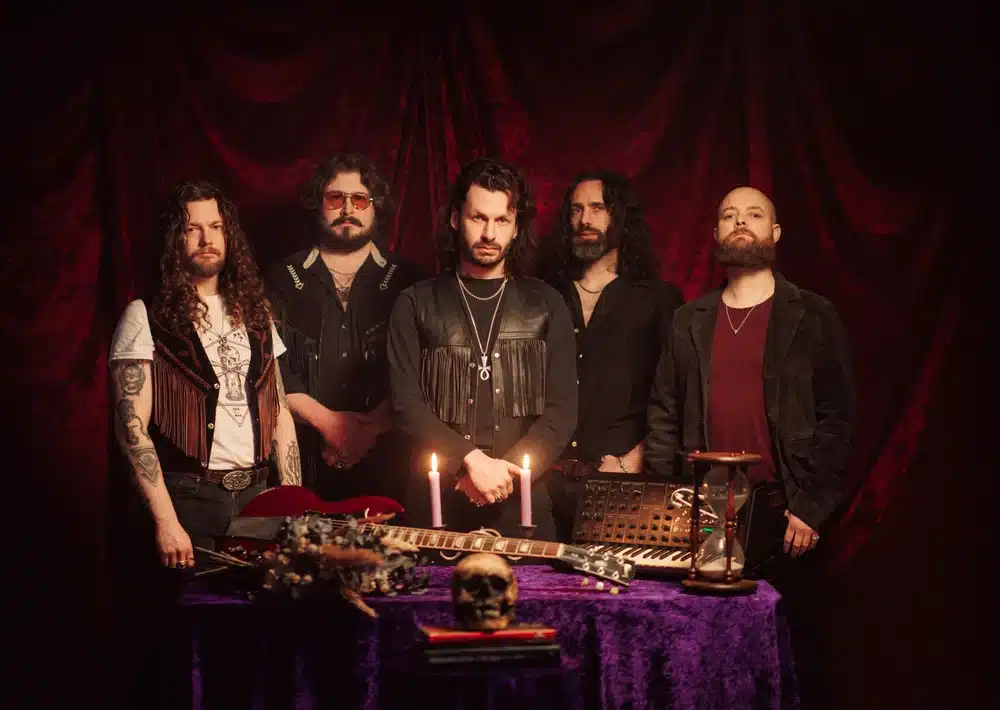
I should declare my bias at the door. I have been in the congregation since Woodland Rites, and I have not missed a service since. Green Lung are the band I press on friends who claim modern metal has forgotten how to write a chorus, the band whose vinyl I buy twice because one copy is for playing and one is for looking at. So when word came that the London five-piece had returned from Rockfield Studios with a fourth album about the corpse-roads and cemeteries of their own city, I approached it the way a devotee approaches a relic: hopeful, protective, and quietly terrified that the spell might finally break. It has not.
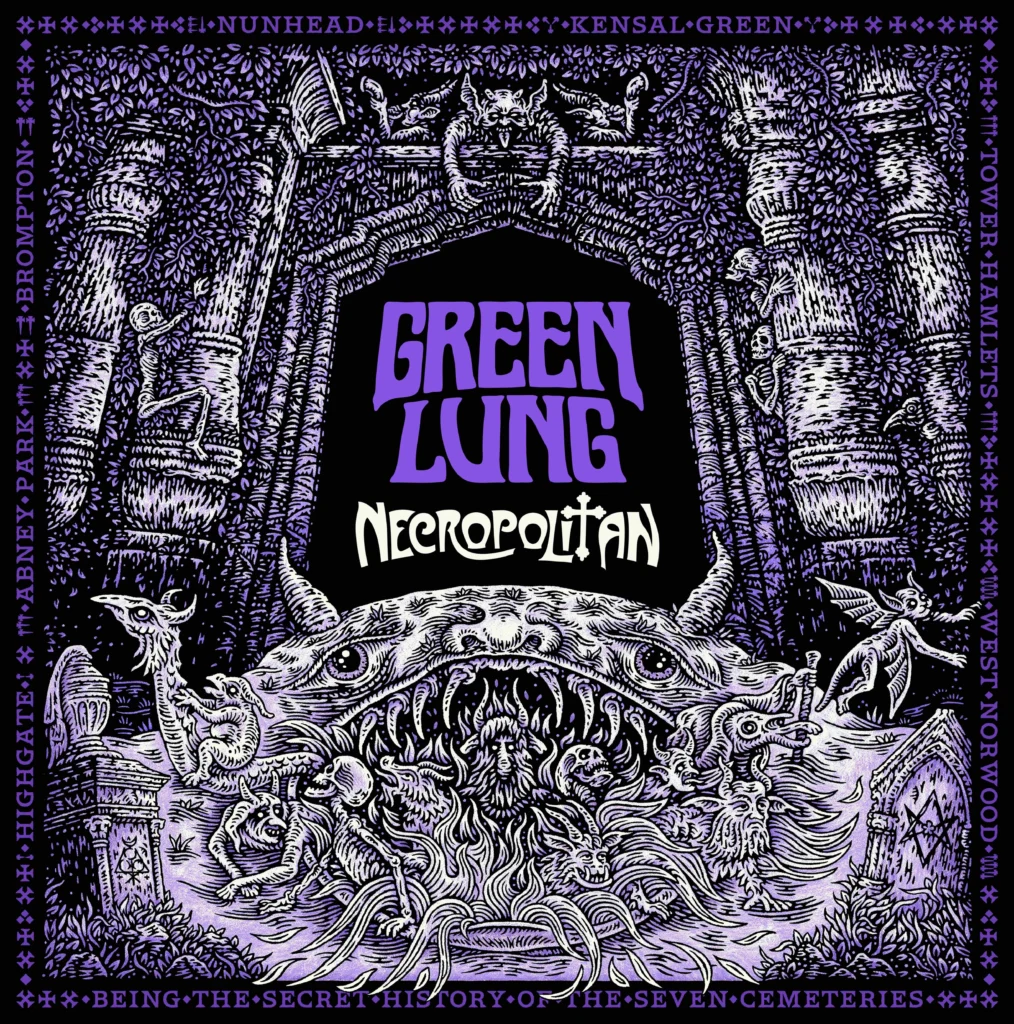
The useful way to measure this band’s four records is not by weight but by what each one asks of you. Woodland Rites asked only that you turn it up. Black Harvest asked you to notice that the jokes had teeth. This Heathen Land asked for an afternoon, a lyric sheet and a willingness to be led somewhere. Necropolitan asks for something different again: it wants you to accept that the uncanny is not a rural export. Tom Templar has spent three albums writing about Britain as a haunted hinterland, and the assumption crept in that the wyrd lived exclusively past the last bus stop. This record relocates the whole apparatus to the capital and loses nothing in transit, taking its bearings from the ring of Victorian garden cemeteries built by industrialists who wanted monuments and got ivy instead.
That relocation is matched by a change in working method that you can hear inside ten seconds. This Heathen Land was built in the studio over roughly a month, layered and polished until it gleamed, and the band then had to teach themselves to play it. This time they inverted the sequence, spending half a year hammering the material out in their rehearsal room before Tom Dalgety captured the results in nine days, with drums, bass and rhythm guitar tracked live in the room together. The previous album sounded designed. This one sounds performed. It is a distinction that matters enormously for a band whose reputation was built on stages.
The record’s centre of gravity is its two velocity tracks, and they arrive from opposite directions. Necropolitan Line is the fastest thing the band have ever recorded, a runaway service from Waterloo to Brookwood that treats the real Victorian corpse-railway as an excuse for pure momentum. Dance to the Grave is slower but hits harder, and it is the closest Templar has come to writing a protest song wearing a skull mask: everything passes, the markets consume the rest, so we may as well waltz toward the pit with a drink in hand. Matt Wiseman drives both with a swing that never tips into showiness. Between them they establish that this album has no interest in being admired from a distance.
Then there are the two songs where the band stop being musicians and start playing characters. Black Magick Radio is the most committed piece of world-building here, an entire fictional broadcast constructed out of vintage keyboard tone and ritual chanting, with J.G. Wright doing the heaviest lifting of his career. Evil in This House works the same trick in a different genre, a haunted-house set piece built on a riff so unapologetically indebted to Black Sabbath that resistance is pointless. Both tracks understand something the band have known since the beginning, which is that atmosphere only works when it is anchored to something you can actually headbang to.
The portrait songs are where the ambition pays its richest dividend. Alostrael (Be My Babalon) recovers Leah Hirsig from the footnotes of Aleister Crowley‘s legend, and the decision to hand narration duties to Riley Pinkerton of Castle Rat is inspired: for the first time, this mythology is not a one-man broadcast. Ozymandias approaches the same theme from the comic angle, taking Shelley’s ruined colossus and reading it as the punchline the cemeteries have been telling all along. Every industrialist under that ivy commissioned a monument. Nobody remembers a single name.
The bookends do quieter work. Open the Hellmouth functions as an overture rather than a battering ram, and To the Gallows Born gathers the Tyburn dead for a closing procession that resolves the album’s argument rather than simply ending it. Together in Death sits between the extremes, and it is here that Joseph Ghast‘s bass playing deserves the mention it rarely receives. The low end on this record is not a foundation, it is a presence. Credit is due as well to Scott Black, whose editing instincts appear to have governed the entire album; nothing here outstays its purpose, and the songs are more powerful for the amputations.
My only reservation, offered in good faith, is that nine songs go by very fast, and anyone who fell for the widescreen sprawl of the last record may briefly miss the ambient corridors between rooms. That is a matter of taste rather than a flaw. Templar has described the four albums as seasons, with this one arriving as winter, and winter records are supposed to be bare. The band chose impact over expanse and they were right, but it does mean Necropolitan rewards repetition more than it rewards patience.
In conclusion, this is the record that converts Green Lung from a cult concern into a genuine inheritance. It is heavier without being humourless, conceptually rigorous without ever becoming homework, and performed with the confidence of a unit that has spent three years learning what it sounds like in front of a crowd and then insisted on capturing precisely that. The band set out to prove that their elaborate occult rock could land as hard on record as it does live, and they have done so while writing their sharpest set of songs. Nine tracks, no filler, and a mythology deep enough to keep unfolding for another decade. Britain’s heavy tradition has not been handed on so convincingly in years.
My personal favourites are Dance to the Grave, which I have not been able to dislodge from my head since the first spin, Necropolitan Line for sheer reckless velocity, and Alostrael (Be My Babalon), which is the track I suspect will still be revealing itself in six months.
Purchase / stream Necropolitan: https://greenlung.bfan.link/necropolitan.yde
ALBUM DETAILS
Album: Necropolitan
Artist: Green Lung
Release Date: September 11th, 2026
Label: Nuclear Blast Records
Rating: 9/10
Tracklist:
- Open the Hellmouth
- Dance to the Grave
- Black Magick Radio
- Necropolitan Line
- Evil in this House
- Together in Death
- Ozymandias
- Alostrael (Be My Babalon)
- To the Gallows Born
Band Members:
- Tom Templar – vocals
- Scott Black – guitar
- Joseph Ghast – bass
- J.G. Wright – keyboards
- Matt Wiseman – drums
Additional Musicians:
- Riley Pinkerton (Castle Rat) – narration on Alostrael (Be My Babalon)
- Tracy, Luke, Lucy, Joe and Sasha – ritual chanting on Black Magick Radio
- Tom Templar – field recordings
Additional Personnel:
- Tom Dalgety – producer, recording, mixing
- Tim Lewis – engineer
- Robin Schmidt (24-96 Mastering) – mastering
- Richard Wells – illustration and graphic design
- Tom Templar – art direction
- Andy Ford – gatefold and poster photography
- Sinead Skinner – In Memoriam photography
- Ian Dickinson (5B Artist Management) – management
- Nathan Barley Phillips – A&R (Nuclear Blast Records)
- Oleg Bounetsky – project management
- Lisa Cope – digital marketing
- Claire Harris & Arne Jamelle – publicity
- Published by AMF Music Publishing, administered by Kobalt


